
Foundational – making scales obvious

An artist loads a palette with colours for the mood of the painting. Conceptually, a musician uses a palette of sounds to use for the mood, the emotions, to be conveyed to the listener. The palette is loaded with scale notes. We’ll explore this below.
You don’t need to play guitar or piano to successfully try this and come away understanding how to create the major scale anywhere, and create chords from those notes.
Pre-requisites: None
Let’s get going 🙂 Click on a section below to expand or collapse it
Semitone, Octave, Labelling notes
There are 88 frequencies singled out for musical notes. A grand piano can produce all of these. A 24-fret, 6-string guitar can produce 48 of these. Theory very sensibly assigns names to these (who wants to tallk about frequencies other than sound engineers, and sound designers?).
But you need to be aware how these frequencies are singled out, and then forget it. This is because we can use a different scheme for identifying notes, without using note names, which will drastically? simplify your learning, and make theory visually utterly obvious. The frequency “of” some piano key? is a mathematically-derived magic number (roughly 1.059) times the frequency “of” the piano key immediately to its left. We say the sounds created by these two keys are a semitone apart in frequency. As a result, starting at any piano key, the next eleven keys produce sounds that are one to eleven semitones higher, and the twelvth piano key produces double the frequency, which we say is an octave higher.
Intervals
These are the true foundations of all musical sounds. An interval always involves two notes. For example, we’d say that two notes 3 semitones apart creates an interval of 3 semitones.
When both notes are played at the same time, we say we hear a harmonic interval. If one note is played, then the other, we hear a melodic interval.
Either way, our brains can recognise these, even if we know nothing about music. With ear training, we can recognise these different intervals. ? For example, we may recognise the sound of 3 semitones, which theory calls a “minor 3rd”, or 4 semitones (“a major 3rd”), which sound dramatically different to each other. In later lessons, you’ll learn about interval names, and hand shapes used to create these (on guitar or piano). With ear training, you can then associate the sound (via the interval name) with a hand shape.
Labelling using semitones
We could conceptually label the 88 keys of a grand piano with the numbers 0 to 87, representing how many semitones higher than the left most key is produced at that label. (The interval each forms with the left-most key). Here are a few of these (and emuso’s “piano” starts at the 16th note of a grand piano)
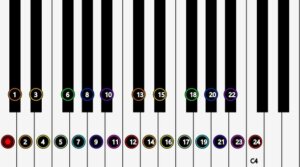
More usefully, we can visualise the piano being made up of adjacent blocks of 12 notes, and label each block 0 to 11.
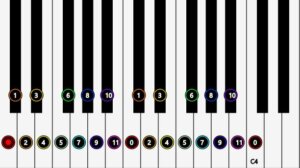 .
.
Check it out. Click this “eye-ear” icon (make sure the Toolkit button is not active). You will hear the block start note (0) in several octaves. You will be asked to use the Play Construct tool at the far left of emuso. It will either show a button labelled “Harmonic” or “Melodic”. This button can be clicked. If “Harmonic” you can hold the button down, rather than clicking, and the sound will last until you release it, or fades out.

I can now ask you to use notes at various labels 0 to 11, maybe within a particular block, to create specific sound flavours.
In fact I could give a name to what you’ve just tried … when all 12 notes in a block are involved, we call this the chromatic scale. The common scales you will encounter range from 5 to 8 notes in a block.
You’re now going to create the “minor pentatonic” scale.
A scale name is short hand for which semitones are involved.
The minor pentatonic uses semitones 0, 3, 5, 7, and 10.
The major scale
The major scale is the father of them all, in terms of common usage.
It requires semitones 0 2 4 5 7 9 and 11.
A block doesn't have to start at the far left
Here’s the major scale again … listen to it
And now we’ll shift its start note, where the label 0 is assigned. Watch what happens. Listen to it again. Can you hear it’s the same sound flavour, just shifted higher. The labelling of semitones does not change!? This reflects that our brains hear notes RELATIVE to a specific note. We identify the semitones from the start note, even if we know nothing about music. Not only that,we can do this when there’s other sounds present, like conversations. Computers can’t do that!
This is essentially what we do, if a singer, say, couldn’t sing a melody using notes required based on the semitones from the current start note. We’d try different start notes until the singer feels comfortable. It might also be that a pianist isn’t familiar with playing these notes, and wants the start note repositioned to something that is familiar (such as the far left we started with)
If we looked up the note name for label 0 (move the mouse over it and you’ll see a name swell up underneath the piano). Suppose that name is “D”. Musicians would say music created is in the “Key of D Major“.
If these notes were played in random order, the listener wouldn’t know what’s going on. The composer or improviser needs to emphasise some notes (some labels) more than others, so the listener hears this music as revolving around label zero (D in this case).
Summary
You’ve seen that there are twelve different notes available in a block of 12 piano keys, which we can label 0 to 11, with 0 being where we arbitrarily choose. These then repeat in several adjacent blocks. A scale typically uses some of these, including 0 (we call this the tonic). These distances determine the sound flavour of the scale. Different scale types are defind by different distances. Major scale requires distances 0 2 4 5 7 9 11. You’ve seen moving the scale around maintains these distances, and the sound flavour is the same, just higher or lower.
Music theory never uses these labels, and instead use other symbols, which is what we’ll look at in the next lesson. But using these distances makes it very clear what’s going on, and where.


